Quick answer
An excavator cooling system uses the radiator, hydraulic oil cooler, fan, water pump and thermostat together to keep the engine and oil within a safe temperature range. When one link weakens, heat builds up and the machine loses power. Clean cores, a strong fan, a good thermostat and the right coolant are the simplest way to keep it cool.
The excavator cooling system is the cluster of parts that keeps the engine and the hydraulic oil within a safe temperature range while the machine works under heavy load all day on site. It includes the radiator, the hydraulic oil cooler, the fan, the water pump and the thermostat, all working together. When one link weakens, heat piles up, the machine loses power and parts wear faster. Understanding how they work lets you keep the machine cool without wasting money on parts you do not yet need.
What parts make up the excavator cooling system?
The cooling pack on an excavator is not a single radiator like a car. It usually stacks several cores side by side: the engine radiator, the hydraulic oil cooler, sometimes a transmission oil cooler and a charge-air cooler. One large fan pulls or pushes air through all of those cores. The water pump circulates coolant, and the thermostat decides when coolant is allowed to pass through the radiator.
How does the engine radiator work?
The radiator takes hot coolant from the engine block and spreads it across hundreds of small tubes with cooling fins. Air flowing across those fins carries the heat away, the coolant cools down and returns to the engine. The heavier the load, the hotter the coolant, so the radiator face must stay clean and open. A single caked layer of mud drops its heat rejection noticeably. The pressure cap plays a part too: it holds the coolant at slightly higher pressure so it boils later. A weak cap with a hardened seal lets coolant push out and get lost, so the machine heats up fast while owners often forget this small item.
The hydraulic oil cooler and heat rejection
Hydraulic oil makes heat every time it squeezes through a valve, through the pump, and each time the boom stops suddenly. That heat has to leave at the oil cooler, usually sitting right in front of or beside the radiator in the same pack. If the oil runs too hot, it thins out, the oil film gets thinner and the pump starts to wear quickly. So the oil cooler matters as much as the radiator, even though many people rarely look at it.
The fan and the airflow through the cores
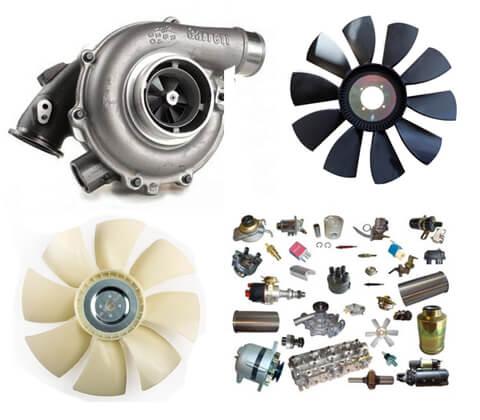
The fan is what creates forced airflow when the machine stands still or idles. There are puller fans that draw air through the cores and pusher fans; many newer machines use a reversible hydraulic fan that blows backward to self-clean the cores. The airflow must pass fully across the core face, not leak or swirl away. Without the shroud, or with it fitted wrong, air escapes and the whole pack cools poorly. A cracked or chipped blade, or a fan missing one blade, weakens the airflow and shakes. When replacing a fan, match the blade count and the blade pitch, because fitting it the wrong way blows air in the wrong direction and the cores get no cooling at all.
The water pump and thermostat set the rhythm
The water pump keeps coolant circulating between the engine and the radiator. The thermostat stays closed while the machine is cold so it reaches working temperature quickly, then opens once it is hot enough. If it sticks closed, coolant does not reach the radiator and the machine overheats very fast. If it sticks open, the machine warms slowly and runs below its best temperature, which is also bad for the engine.
Why does an excavator overheat more easily than a car?
An excavator works standing in one place, under heavy and continuous load, so it gets none of the natural airflow a car has on the road. All the cooling depends on the fan. On top of that, the machine sits on dusty, muddy sites where straw and debris easily choke the core face. That is why the cooling pack needs closer attention than a passenger car.
Use the right coolant, not just plain water
Purpose-made coolant does more than cool; it also fights corrosion and scale inside the water jacket. Plain water over time breeds rust and lime scale that clog the radiator tubes from the inside. Internal scale is hard to see but slowly kills heat rejection. Use the correct fluid and change it on the maker's schedule, as the service guidance from Kobelco sets out.
How does hot hydraulic oil affect the whole machine?
When the oil overheats, its viscosity drops and pressure will not hold steady. Digging force fades, the controls feel slow and the pump has to work harder to compensate. High heat also ages the seals faster, which leads to leaks at the joints. Keeping the oil cool is the same as protecting the life of the pump and the valves.
Signs the cooling pack is starting to weaken
There are a few early warnings you can feel right from the seat. The temperature needle sits higher than usual even though the load has not changed. The machine loses power on a hot afternoon, the fan roars louder, or a faint smell of boiling coolant drifts by. When you see the signs of an overheating excavator, do not try to finish the shift; stopping to check early is far cheaper.
Dirty, debris-choked cores — the number one cause of heat
On Vietnamese sites, the most common cause of overheating is simply a dirty core. Dry mud, straw, leaves and dust build into a mat that seals the air gaps. From the outside the core can look fine while the middle layer is packed solid. A proper wash often drops the temperature straight away with nothing replaced. If the machine works where there is a lot of lint, straw or cement dust, the cores block very fast, sometimes in just a few days. In that kind of environment you must check the core face more often, not wait for the needle to climb.
Clean the cores properly, without flattening the fins
Spray water from the back toward the front, against the direction the dust settled, to push the debris out rather than driving it deeper. Use moderate pressure; too much force flattens the fins and blocks the air even more. For an oil cooler caked with oily grime and dust, use a suitable degreaser first, then rinse it clean. See how to go about cleaning the oil cooler so you do it right and safely.
Weak fan, belt and fan clutch
However good a fan is, it means nothing if it spins slowly. A loose, perished or glazed belt lets the fan slip and starve the pack of air. On a fan with a thermal clutch, a worn clutch stops the fan grabbing when strong airflow is needed. Listening to the fan and feeling the air is a quick on-the-spot check. You should also check the pulley and bearing; a worn bearing makes the fan wobble, waste air and chew up belts. A correctly sized, properly tensioned belt is a small investment for steady airflow all shift.
A stuck thermostat — small fault, big consequences
A thermostat stuck closed can overheat the machine within minutes of starting. Many people rush to remove it entirely to run cooler, but that is a mistake. Without it, the machine runs cold, fuel and oil burn less cleanly, and over time that harms the engine. Fitting the correct thermostat is still the right, lasting fix. A field check: right after starting, the upper hose should stay cool for a while then get hot as the thermostat opens. If the upper hose is hot immediately, or stays cold forever, the thermostat has a problem and needs a close look.
Dirty hydraulic filters also heat the oil
When a hydraulic filter clogs, the oil is restricted and makes more heat as it squeezes through. The bypass valve opens, dirty oil takes the shortcut around the filter, wear rises and heat rises with it. Changing the filter on time keeps the oil flowing freely and running cooler. See the range of hydraulic filters that suit your machine model.
When should you replace a core instead of just washing it?
If the tubes have corroded through, are leaking, or the fins have rotted away, washing will not save it. A core patched in many places tends to leak again and loses cooling area. When heat rejection stays low even after a clean wash, it is time to think about replacing it. Choose a core with fin density and tube material equivalent to genuine parts to keep the performance. A cheap patched core looks cheaper up front but tends to leak again and costs machine downtime. Counting the repeated labor to fit and remove it, a single good core often works out cheaper.
Choosing cooling parts: genuine or aftermarket?
Cores, fans, valves and water pumps all come in both genuine and aftermarket versions on the market. Genuine parts tend to be stable in size and material, but the price varies with the machine model and the supply source. Good aftermarket parts still serve well if you pick a reputable supplier and the correct spec. For the hydraulic components that come with it, such as the pump, valve or regulator, JIC Hydraulics is the line we distribute and trust for its good material, precise machining and clear warranty.
A maintenance schedule for the cooling pack
- Every day: glance at the core face, clear large debris, check the coolant level while the machine is cold.
- Every week: wash off the dust, check belt tension and listen to the fan.
- Periodically: change the coolant, check the thermostat and the pressure cap.
- Seasonally: before the hot season, deep-clean the whole pack and inspect the fins closely.
Quick check table when the needle climbs
| Symptom | First suspect | What to do |
|---|---|---|
| Heats up gradually all day | Dirty, choked core | Wash the core face clean |
| Heats up fast after starting | Stuck thermostat, low coolant | Check coolant and thermostat |
| Fan roars but still hot | Slipping belt, worn fan clutch | Check belt and fan clutch |
| Hot oil, weak controls | Dirty oil cooler, clogged filter | Clean oil cooler, change filter |
| Losing coolant, steam | Leaking core, weak pressure cap | Find the leak, replace the cap |
Common mistakes that make the machine hotter
Removing the thermostat, flattening the core fins, or running plain water instead of coolant are all familiar traps. Add a dirty air plenum or a missing shroud and the cleaning work goes to waste. Fixing the real cause is always cheaper than firefighting the same problem again and again. If you need a matched set of parts, see the heavy-equipment parts that fit your machine model.
Keeping the machine cool keeps it productive
A healthy cooling pack lets the machine hold its power through the shift, saves fuel and extends pump life. Most overheating trouble comes from simple things: dirty cores, a weak fan, a stuck thermostat. Watching them regularly saves you from breakdowns in the middle of a job and from big repairs later. A machine that runs cool is a machine that earns steadily and sits idle less. If you need advice on the right core, fan, valve or filter for your machine, the Viet Trung Hai technical team is ready to help.
Key takeaways
- The cooling pack combines a radiator, oil cooler, fan, water pump and thermostat.
- The most common cause of overheating is a dirty core choking the air gaps.
- Wash the core against the dust, at moderate pressure, so you do not flatten the fins.
- Do not remove the thermostat; fit the correct one for a lasting fix.
- A clogged hydraulic filter and a weak pressure cap also cause heat.
- A corroded, leaking core is better replaced outright than patched repeatedly.
Written by
Phạm Đức Thắng
Phạm Đức Thắng focuses on the undercarriage, tracks and the travel and swing systems of excavators. He writes about how these systems are built, travel and swing motors, and protecting the undercarriage from wear.
Related parts
The exact parts discussed above — send your machine model or pump code to match.