Quick answer
Choosing the right bearing brand means choosing by the machine, the mounting position, and the load type before the name. Steel material, machining precision, and the source decide real durability, not a low price. For heavy-load positions on construction machines, favor a maker with a warranty and a clear designation.
Choosing the right bearing brand decides whether a machine runs smooth or shakes, lasts long or fails early. Bearings support the shaft, carry load, and keep rotating parts on center, so one weak bearing can wreck a whole pump or swing assembly. This guide speaks plainly about trustworthy bearing brands for construction machines, how they differ in material and durability, and how to pick the right type by mounting position. My rule is simple: choose by the machine and the exact spot, not by low price or advertising.
What a bearing brand is and why it matters
When I talk about a bearing brand, I do not mean the mark stamped on the outer ring. I mean the maker behind the steel, the heat treatment, the roundness of the rolling elements, and the smoothness of the raceway. A reputable maker controls how uniform each ball is and how hard the surface stays. That is what decides how long a bearing runs quiet before it goes loose.
Buyers often look only at price and outside dimensions. But two bearings that look identical can be completely different inside. What you pay for is the part you cannot see with the naked eye.
What bearings do in construction machines
A bearing lets a shaft turn freely while staying on center. It carries radial load when the shaft presses sideways and axial load when there is thrust along the shaft. On an excavator, bearings sit in the pump, the motor, the swing assembly, the wheels, the rollers, and the idlers.
Each spot demands a different kind of load handling. A pump bearing turns fast and hot; a swing bearing carries heavy load but turns slowly. Understand this and you can pick the right type, instead of grabbing whatever fits the dimension.
Steel material decides most of the durability
The heart of a bearing is the steel in the balls and races. Good product uses bearing steel that is heat treated evenly, with hardness that stays stable from the surface inward. Poor product uses dirty steel, treated unevenly, and after a while the raceway spalls and pits. Once the raceway is pitted, the bearing gets noisy and loose fast.
The cleanliness of the steel matters too. The fewer impurities, the fewer weak points for fatigue cracks. That is why, at the same size, a bearing from a good maker lasts far longer than a no-name one. If you want to go deeper on judging material, read our guide on part quality.
Machining and precision: what the eye cannot see
Beyond steel, machining precision creates a big difference. The balls must be evenly round, the raceway smooth and concentric, and the internal clearance within tolerance. A small error and the bearing vibrates, runs hot, and wears unevenly. An experienced hand can feel smoothness or grit just by turning the bearing.
The cage that holds the balls must also be strong and light. A weak cage lets the balls knock together, building heat and a rattling sound. These small details are invisible on the shelf, but they decide the real life of the bearing.
Common bearing brands on the market
In the Vietnamese construction-machine market, you will meet many different bearing brands. There are long-established European makers, Japanese makers that ride along with many machine generations, and low-cost commodity lines. A name is not everything, but it reflects how well quality has been controlled over the years.
What matters is that each maker is strong in certain bearing types. Some are good at ball bearings, some at tapered roller bearings for heavy load. Choosing a bearing brand should go together with choosing the right bearing type for the mounting position, not just the name.
ZVL Slovakia bearings: the quality option we distribute
For bearings, the quality option we recommend first is ZVL Slovakia, a brand we distribute officially. ZVL is a long-established European bearing maker, strong in bearing steel and machining precision. What I value is the consistency between batches and a clear warranty.
I will not give technical numbers here, because specifications must be looked up by the exact designation of each bearing. But in terms of material, durability, and precision, ZVL is a trustworthy quality level for heavy-load positions on construction machines. This is aftermarket product built to European standards, not no-name stock.
SKF bearings and technical documentation
SKF is one of the most cited bearing makers when the talk turns to standards and technical documentation. Their designation charts, mounting guides, and life data are used widely as a reference across the industry. When you need to understand what a bearing designation means or how to arrange bearings, the documentation from SKF is worth reading.
That does not mean every machine must use a single brand. My point is how the big makers standardize designations and tolerances. Once you grasp the common standard, it is easier to compare across bearing brands and avoid buying the wrong type.
Genuine bearings by machine and aftermarket bearings
Bearings on a machine fall into two familiar source groups. Genuine parts come with the pump or motor assembly from the machine maker, and are usually not easy to buy loose. Aftermarket parts are made by independent bearing makers, fit the same fit, and meet that maker own standard.
For many positions, an aftermarket bearing from a reputable maker lasts as long as the genuine one, while being easier to buy and more reasonably priced. The catch is choosing the right maker and the right designation. This is where experience and a trustworthy source have real value.
How do you pick the right bearing brand by mounting position?
The short answer: choose by the load type and working condition of each spot. A fast, hot bearing needs a type that handles heat and runs smooth. A heavy-load, slow bearing needs high load capacity, like a tapered roller or a cylindrical roller. Do not shove a common ball bearing into a spot that should use a roller bearing.
The practical steps are three:
- Read the old bearing designation correctly before removal, and record it clearly.
- Identify the mounting position and load type: radial, axial, or both.
- Choose the bearing brand and type that fit, favoring a maker with a warranty.
If you are still unsure between a rolling bearing and a plain bushing for a spot, our guide on choosing bearings and bushings goes deeper into the decision.
Bearings in hydraulic pumps and motors
In the pump and hydraulic motor assembly, bearings support a shaft turning at high speed in hot oil. Here, precision and steel cleanliness matter a lot, because one small flake of spall travels with the oil through the whole system. A poor bearing in a pump does not just fail itself; it drags along expensive damage.
When I overhaul a pump, I always replace the bearings along with the seal kit, never reusing old ones. For the hydraulic side, we favor JIC Hydraulics for pump cartridges and valves, and for the bearings we use a standard-grade product like ZVL. Mixing a no-name bearing into a good pump is asking for trouble.
Swing bearings and heavy-load supports
The swing assembly carries the full weight of the upper machine as it rotates. The bearing here turns slowly but carries very heavy, constantly changing load during digging. The type used in this spot is usually a roller bearing or a combined-load bearing, demanding good steel and hard races.
Choosing the wrong maker here is very costly, because removing and refitting the swing assembly takes a lot of work. I always advise owners to use a bearing brand with proven durability for heavy-load positions. Saving a little here often costs many times more later.
Wheel, roller, and idler bearings
In the undercarriage, bearings sit inside rollers, idlers, and wheels. They face dust, mud, water, and constant impact. Here, sealing and grease retention matter as much as steel hardness. An open bearing that loses its grease wears out very fast.
For the undercarriage, you need a bearing that handles impact load and a tight dust seal. This is also the group most often replaced with the cheapest product, and the one that fails earliest. See the heavy-equipment parts we supply for this group.
How to read the markings on a bearing
The markings on a bearing tell the bearing type, the size, and some features like cage type or clearance. The numbers and letters on the outer ring are not random; they follow a common industry standard. Read the designation and you buy the right type without depending entirely on the seller.
A practical tip is to photograph the old bearing designation clearly before removal. If the marking is worn away, look it up by measured dimensions and mounting position. Do not guess, because one wrong character can point to a completely different bearing.
Spotting fake bearings and gray-market stock
Fakes copying big bearing brands are not rare on the market. Common signs are blurry stamping, a rough outer-ring surface, and grit or squeal when you turn it by hand. Boxes and labels are often off-color or smudged compared to the real thing. But the outside look is not always reliable.
The safest way is to buy from a distributor with a clear source and a warranty. An unusually low price is almost always a suspicious sign. A fake bearing fitted in a heavy-load spot can shatter mid-shift, dragging along far bigger damage.
Quick comparison of bearing groups
The table below sums up the differences between the three bearing groups you often meet. This is a qualitative comparison to help you picture it, not a spec sheet.
| Criterion | Reputable EU/Japan maker | Named commodity line | No-name stock |
|---|---|---|---|
| Steel quality | Stable, uniform | Fair | Uncontrolled |
| Precision | High | Fair | Low, often off |
| Real durability | Durable, long and quiet | Acceptable | Fails early |
| Warranty | Clear | Maybe or none | Almost none |
| Position fit | All spots, including heavy load | Light-load spots | Should not use |
Which bearing type for which position?
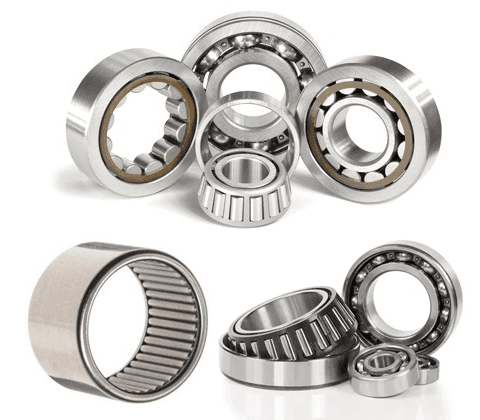
In short, from experience: ball bearings suit fast shafts with light to medium load. Cylindrical roller bearings handle heavy radial load better. Tapered roller bearings carry both radial and axial load, suiting wheels and some thrust-loaded assemblies. Choose the right bearing type first, then the brand.
Do not force one bearing type into every position. Construction machines have far too many load types to share one kind. If the bearing type is wrong, even the best maker fails quickly.
Signs a bearing is about to fail while running
Bearings rarely fail suddenly with no warning. Early signs are usually a steady hum that grows louder, or a grinding sound when turning. Touching the housing near the bearing and feeling more heat than usual is also a warning. Shaft play and vibration mean the bearing is already fairly worn.
Listening and touching regularly help you catch trouble early. Replacing a bearing before it shatters is far cheaper than fixing the whole assembly after it seizes. Do not ignore a strange noise; the machine is telling you something.
Fitting bearings correctly so you do not ruin good stock
A good bearing still fails early if fitted wrong. A common mistake is knocking directly on the inner ring while pressing onto the shaft, pitting the raceway from the start. You must press evenly through the correct load-bearing ring, use the right tools, and keep it absolutely clean. Even one trapped speck of dust can start a wear point.
Heat and force must be controlled during fitting. If heating is needed to fit, do it evenly and just enough, without overheating. Sloppy fitting is the fastest way to turn good stock into scrap.
Storing and lubricating bearings
A bearing lives on the film of oil or grease between the balls and the raceway. Without lubrication, it is metal on metal, building heat and wearing instantly. Use the right grease and the right amount, neither packed too full nor left dry. Lubricating on schedule matters as much as choosing the right maker.
When storing, keep bearings in a sealed box, away from damp and dust. A bearing left open for a long time easily gets light rust on the raceway, and it will be noisy as soon as it runs. Good storage keeps the bearing precise until it is fitted.
Common mistakes when buying bearings
The most common mistake is looking only at price and size, ignoring the bearing type and the source. Many people buy the cheapest bearing for a heavy-load spot, then wonder why it fails fast. Another mistake is reusing old bearings when overhauling an expensive assembly, thinking they save money when they actually lose it.
The third mistake is trusting advertising over the designation and the origin. A good bearing brand always comes with a clear designation and a seller who takes responsibility. If the seller cannot state the source, that is a sign to stop.
Choosing the source and the warranty
For bearings, the source matters as much as the brand. For the same maker, officially imported product from a reputable distributor is very different from hand-carried stock of unknown batch. A clear warranty is how the seller commits to quality. Without a warranty, the whole risk falls on you.
We favor makers with a transparent distribution system and support for looking up designations. For bearings, that is why we chose ZVL Slovakia as our officially distributed quality line. You get the right product, the right designation, and a party who takes responsibility.
Closing: choose the bearing brand by the machine, not the price
Choosing the right bearing brand means choosing by the machine, the mounting position, and the load type, and only then the name on the outer ring. Steel material, machining precision, and the source decide the real life, not the listed price. Choose right once, and you avoid many costly rounds of removal and refitting.
If you need advice picking the right bearing for your machine, see our heavy-equipment parts or contact our technical team for the correct designation.
Key takeaways
- Choose a bearing brand by the machine, mounting position, and load type, not price.
- Steel material and machining precision decide most of the real durability.
- For our officially distributed quality line, we favor ZVL Slovakia for heavy load.
- An aftermarket bearing from a reputable maker can last as long as a genuine one.
- Always read and record the old bearing designation before removal to buy the right type.
- Buy from a source with a clear warranty; an unusually low price is a suspicious sign.
Written by
Hoàng Anh Dũng
Hoàng Anh Dũng tracks sourcing, pricing and brands for heavy-equipment parts. He writes about what drives price, buying smart and telling apart part origins and quality.
Related parts
The exact parts discussed above — send your machine model or pump code to match.